| western watershed romance |
| about | episodes | musings | voyeur room |
Recently, my boss stated that I
was a “great scientist,” and
contrary to his intention to compliment, I felt disgusted, insulted,
degraded, defamed by such an appellation. I yearned to vomit that stain
off me. Never, during my often-desultory/delusional adult life, have I
considered myself a scientist. Even in my most ludicrous fantasies I
didn’t envision myself as one. In a few nonsense scenes, I saw myself
as a big bad G-man with lots of independent power, in which I
understood, through science, how the plants and animals and rocks and
algae related, but the science was only a means for building fishy,
self-perpetuating ponds and small lakes or dismantling dams for salmon
sake, with me having vast knowledge of both the engineering and
biological aspects of such big undertakings. In other words – me as
demigod. Silly and sinister, I know. In a less fantastical mind-film,
I’d many aquaria in my garage at my remote mountain cabin where I
conducted experiments, experiments not destined for peer-reviewed
scientific journals but merely to enhance my understanding of fishes so
I could catch ‘em better. And the truth for why I went to college and
majored in fisheries science – it was only because I wanted to catch
more fishes and more of each. That was it – purely selfish, no direct
sanctimonious desire to do anyone else any good. After I’d earned my
bachelor’s degree and was working as, titularly, a “scientist” (I was
mainly an environmental-document editor) with the California Department
of Water Resources, my girlfriend asked me what my ideal job was, and
it certainly wasn’t the one I had or as some academic running
experiments on fish and publishing papers in sci pubs and pontificating
at conferences – it was to be a consultant to tackle manufacturers to
craft more-effective lures. So science was never my main focus in my
fantasies or daydreams but merely a tool for a greater purpose: as
demigod, as lure-designer, as fisher, with the latter true, the former
arrogant self-denial, the middle with some veracity (I frequently have
to alter tackle to increase effectiveness). Even after earning a
master’s degree in ecology and embarking on a long-term career as a
fisheries biologist in the San Francisco Estuary Watershed, I studied,
performed, and communicated science, it occupied much of my time, but
never was it an end, and never did I consider it my primary role – I
was foremost a natural historian and fisher.
Still, while in college
and then in my early fisheries career, had someone called me a
scientist, I would’ve felt uneasy about it, but I wouldn’t have loathed
it like I increasingly have the last several years. Back then, I
venerated science, prided myself on being associated with it. I assumed
that if it was published in a peer-reviewed journal, then it was
perfectly sound information, like gospel. Being insecure and desperate
for some signs that I’d ascended a pecking-order ladder, I initially
gobbled up with infatuation all the jargon of the discipline, shit such
as “predating” (not preceding,
but to eat), “metamorph”
(frog),
“ichthyofauna” (uh…fish). I genuflected to statistics. And the
peer-reviewed stuff did help me catch more species of fish and more of
‘em – did improve me as fisher.
Gradually, though, I felt something
wrong with what was labeled “science” in my watershed. I can remember
no threshold, no epiphany, just a slowly fermenting, uneasy,
distasteful sense that something was seriously wrong with both the
endeavor and its practitioners, finally reaching my current gangrenous
agony and forcing me to extricate myself of it with this essay. I
recall a few early warning signs. I reviewed a paper about San
Francisco Estuary marsh fish assemblages (Gewant and Bollens 2012)
destined for a reputable scientific pub, and the authors misassigned
life-history stages as well as ecological type to many fishes. A few
examples: they classified yellowfin goby as a “resident” of freshwater
marshes (yellowfin can’t spawn in fresh water), and their “adults” were
all juvenile fish; they also had the timing of king salmon runs totally
wrong. It was clear that they knew very little about their study
subjects, and yet here they were writing a tract to add to the canon. A
few years later, Bill Fleenor, a warm, walrus-lookin’, robust, ruddy,
brilliant hydrologist highlighted even more the problem. A paper he’d
rejected as a reviewer for one journal was resubmitted to another and
published there (Fox et
al. 2015). It calculated the evaporation rates
of the pre-dam/diversion San Francisco Estuary Watershed riparian
plants, which were far more abundant back then than now, and how that
affected riverine outflow and thus saltwater intrusion. Their
conclusion was that the evaporation rate of the plants was nearly the
same as diversions out of the watershed today, and so the difference in
saltwater intrusion before and after all the diversions was nearly the
same. Internally, the paper reads well, but as Bill pointed out, it was
all bullshit because they used the current channel network to model the
pre-diversion period, and they are way different. Back then, the
channels were much narrower, so it took considerably less fresh water
to push the salt water downstream. That was why Bill rejected this
paper – with sound truth – and yet, the writers didn’t admit their
mistake, but tried to find some other outlet to publish their
bullshit.
A few more examples.
Striped bass in the San Francisco
Estuary is a very popular non-native
sportfish, which has predisposed ‘em to much attention from
fisherpeople as well as scientists, the latter of whom in the early
years sought to understand ‘em to increase their numbers for the
fishery, and lately want to exterminate ‘em because they wear today’s
pejorative of yesterday’s “trash fish”: non-native. Long ago in the
early 1950s, the distribution of the bulk of the adults was well-known:
they were in saltwater bays and in the inshore ocean during summer, the
Delta and fresher-brackish parts of the estuary in autumn and winter,
and in the rivers to spawn in spring. Calhoun showed that very well in
his 1952 paper, and even Tom Stienstra, with whom I often disagree,
knows the same thing (2012, pp 65-66). Most guides fishing for stripers
parallel the location of the mass of fish: they’re in the upper estuary
in autumn and winter, in the rivers during spring, and either in San
Francisco Bay or hugging the coast north and south of the Golden Gate
by about 75 miles during summer.
So – a smart dude in my group, an
outstanding hunter and fisherman and
biologist, brought to my attention a paper about cues triggering
stripers to migrate up the rivers here in the watershed (Goertler et
al. 2021). He smelled something fishy (ha, ha) about it,
and he was
right. The lead author is a woman whose work is largely focused on
salmon, and it’s notable that much of the paper’s introduction about
migrating fishes references salmon studies, not striped bass studies.
Anyway, they used a bunch of flow and temperature variables to see if
they corresponded to catches of stripers in the spawning river,
including river flow (no doubt important); mean springtime temperature
in Suisun Bay (okay, though degree-days – in other words, the
accumulation of heat – would’ve been a more appropriate choice since
the more heat ya got, the faster reproductive development, and
therefore the earlier fish can run up and spawn); and…spring ocean
conditions at the Farallon Islands. Think about that for a second given
the historical knowledge of both fisheries biologists, such as Calhoun,
and fisherpeople, such as Stienstra. Where are the bulk of the adult
striped bass in spring? When in salt water, where are they at? What on
earth do conditions at the Farallon Islands 30 miles out from the
Golden Gate have to do with fish that are more than 50 miles inside
Golden Gate?
Should I put snow chains on if I’m in
Sacramento because it’s snowing
in Truckee? No, because what the roads are like in Truckee ain’t got
shit to do with what they’re like in the capital city. And so what the
temperature at the Farallons has to do with a fish in Montezuma Slough
or Honker Bay or Cache Slough is…nothing. And they found it was a
significant predictor, and it’s obviously a totally spurious finding –
it’s nonsense.
Tellingly, the Calhoun paper wasn’t
cited at all.
And this was published in the revered Nature…
Here’s some more nonsense, this time
about the poor, abused Delta
smelt, a showpiece of the Endangered Species Act. A paper came out in
2019 (Hammock et al.)
examining whether Delta smelt ate better near
tidal wetlands along the main waterways of the estuary, tidal wetlands
the big government water agencies (California Department of Water
Resources and the US Bureau of Reclamation) have been using as
mitigation to keep diverting water out of the estuary. Something about
this paper just didn’t seem right to me, but it took me a while to
figure it out.
We’ve tons of data about lots of stuff
in the San
Francisco Estuary; my main job for 17 years was continuing that data
collection with the Suisun Marsh Fish Study. So light could be shed on
most hypotheses or questions with data already available. And for this
paper, much could’ve been – should’ve
been – quarried or considered.
First, a very simple deduction – if tidal wetlands are really good for
Delta smelt, and tidal wetlands, by definition, are shallow and the
shore – then Delta smelt catches should increase with decrease in both
depth and especially distance to shore. However, one of the better
Delta smelt ecology papers published (Bever et al. 2016) that
considered those two variables found that distance to shore had nothing
to do with abundance and that shallower water was weakly related to
higher catches, but mostly because the water was slower where
shallower, and water speed affected abundance substantially. That no
relationship existed between distance to shore and abundance alone
suggested that tidal wetlands were unimportant to Delta smelt. Second,
they could’ve used Suisun Marsh Fish Study data. It’s simple deduction
that if Delta smelt really dig tidal wetlands, then they should be most
abundant at sites in Suisun Marsh where the area of adjoining tidal
wetlands relative to the area of the slough should be greatest, First
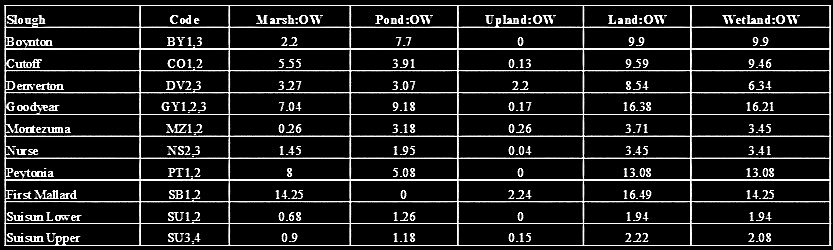
Mallard and Peytonia sloughs especially [i.e., “marsh to
open water
(OW)”; Table 1 (from Colombano et
al. 2020)]. But that’s not the case –
in the entire study’s history, they were most abundant in bigger,
deeper sloughs bordered by diked wetlands (mainly lower Suisun Slough)
and often close to the estuary’s mainstem: Suisun Bay (Figure 1, Table
1). And across sites of the smaller sloughs, the one that had the most
Delta smelt (GY3) was the small-slough site closest to the bay…and it
was surrounded exclusively
by managed wetlands (just take a gander at
any Google Earth image to see that), not tidal (it’s also noteworthy
that two-thirds of the Delta smelt catch in First Mallard Slough were
netted at the downstream site (SB2), which is just a stone’s throw from
big ol’ Suisun Slough; Figure 1). And that’s acknowledging that, yeah,
our ability to catch ‘em at the bigger, deeper sites is less than the
shallower, narrower ones – even more Delta smelt were in the big diked
sloughs than our catches showed. And we’ve seine data, too, for Suisun
and Denverton sloughs, and of the two, Denverton should’ve had more
fish, being shallower and having its whole river-left side bordered by
tidal wetlands – but it didn’t, the big slough, Suisun, did (Figure 2).
So that doesn’t agree with tidal wetlands being super-duper for Delta
smelt, either. THIRD – and yeah, there’s a third – is an omission of
history. Yep, the SFE had lots of tidal wetlands for thousands of
years, coinciding with Delta smelt, and yep, most of those tidal
wetlands were transformed into something else, mostly farmland but some
managed wetlands, most notably in the marsh. So it’s easy to reason
that there were lots of tidal wetlands before the Gold Rush, no doubt
there were more Delta smelt, now there’re few tidal wetlands and NO
Delta smelt (at least real
ones – wild fish, not domesticated hatchery
fish), so bring back the tidal wetlands and – ta da! Delta smelt should
follow. Big problem: the landscape of the estuary has been pretty much
the same now for nearly 100 years, and it was in that landscape that
many Delta smelt were still
swimming around back in the early 1960s
when Cal Fish and Game did a ton of surveys (Kelley 1966, Turner and
Kelley 1966) prior to the State Water Project being built. It wasn’t
until diversions south really began increasing, overbite clam was
introduced, the water really began to warm, and then, in the early
2000s, when the watershed became sediment-limited and began to clear,
then clearing further with increased aquatic plant growth, which
converted pelagic habitat into littoral, that THEN Delta smelt really
took a huge blow. Note tidal wetlands had no role there.
Table
1. Landscape and waterscape
features of Suisun Marsh sloughs (“OW” = open water; from Colombano et al. 2020).
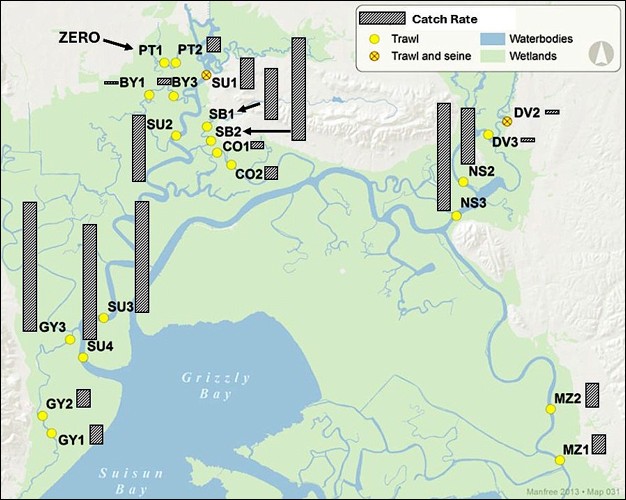
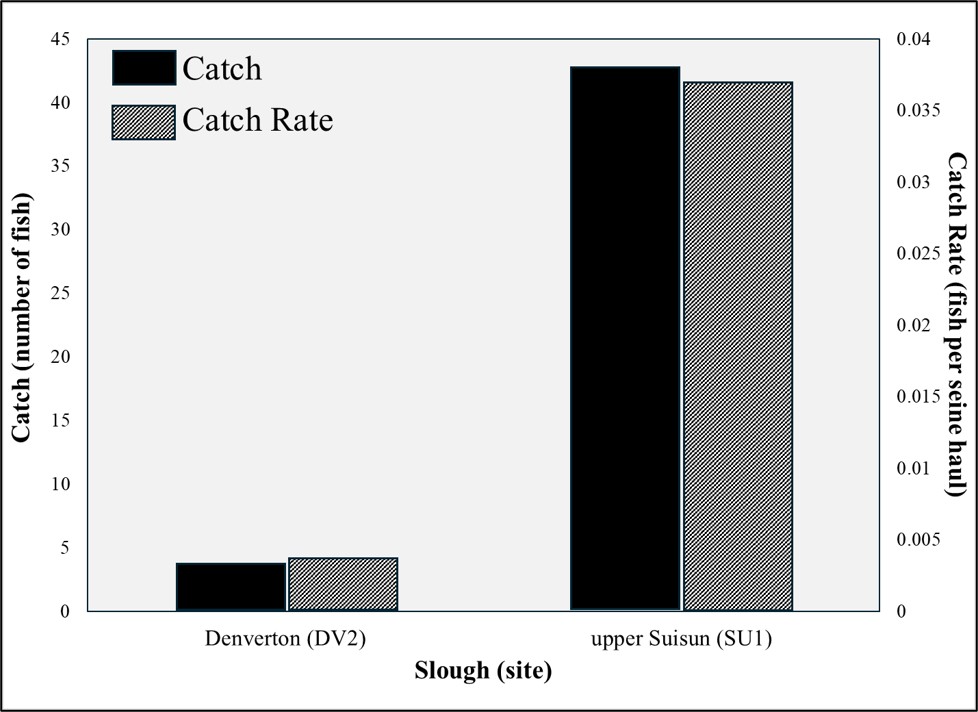 Figure 2. Beach seine numbers of
Delta
smelt in Denverton and upper Suisun sloughs (see Figure 1 for exact
locations;
1,020 and 1,167
Figure 2. Beach seine numbers of
Delta
smelt in Denverton and upper Suisun sloughs (see Figure 1 for exact
locations;
1,020 and 1,167
seine hauls for each site, respectively) from 1994 –
2024 [1980
– 1993 weren’t considered since Denverton was both seined way less
than
upper
Suisun (60 versus 389 seine hauls) and not at all in some years].
The people on
this paper didn’t consider any of that, and, indeed, they found that
the greater the tidal wetland area close to Delta smelt, the more Delta
smelt ate. This is another paper that internally reads
well, and though
I didn’t believe it, I couldn’t figure out why. Then it dawned on me.
Delta smelt like the water muddy. Three areas where these people caught
their fullest fish are frequently the muddiest throughout the northern
estuary: western Montezuma Slough, Suisun Bay, and Liberty Island. What
those locations also have in common is that they are most exposed to
the prevailing southwesterly winds that muddy up the water – like Bever
et al.
(2016) noted, but, further – and which wasn’t considered – is
that they develop windrows more than other areas, and windrows
concentrate plankton – Delta smelt food.
Years ago a dude wanted me to
get him zooplankton for biochemical analyses. I dragged my net in
Montezuma Slough, right where the government agencies sample, but
unlike them, I only dragged it through windrows. He was always blown
away by how many more zoops I got him than the others.
Tidal wetlands had nothing to do with
those stuffed Delta smelt in that
paper – it’s because the wetlands were close to the muddy water where
windrows formed most frequently and made it easier for the little fish
to catch food (check out Figure 1 again – note the orientation of the
NS3 site…southwest to northeast). And the ironic reality is that that
little fish is most at home in big water (again, take a look at Figure
1, especially the NS and DV sites), partly because bigger waterways are
more exposed to the wind than smaller waterways.
An assumption is that our science is
supposed to help endangered
fishes. It sure as fuck doesn’t seem to be helping this animal but, if
just following the correlation between number of papers published and
their abundance, harming them (Figure 3).
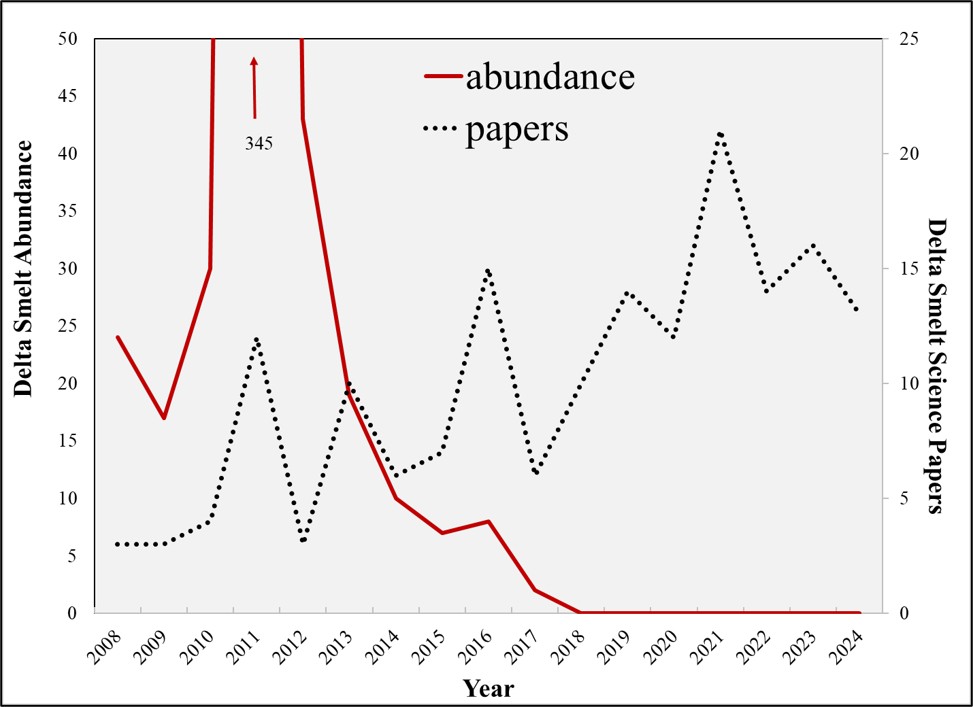 Figure 3. The benefit of
science for an
endangered fish1.
Figure 3. The benefit of
science for an
endangered fish1.
And, by the way, Delta smelt
are actually extinct – domesticated fish dumped into the water don’t
fucking count.
And salmon – ah, salmon. King fuckin’
salmon, the SFE Chinook, man –
another fish plastered with the endangered label (from both state and
country) and likewise used and abused despite the professed love of
everyone, including fisheries biologists. I love ‘em, too – I love all
fishes, just my love runs stronger for some more than others, strongest
always for wild fishes, especially natives but non-natives as well,
mainly stripers, spotted bass, minnows (carp are fucking awesome, as
well as our big native minnows: hardhead, splittail, pikeminnow,
hitch), and salmonids (mackinaw and red salmon are my soul). And so
much research is thrown at kings in our watershed, and yet not only has
the recreational ocean fishery been closed the last two years (2023 and
2024), but the river fishery, too. So something, like for Delta smelt,
seems seriously broken with our salmon science, and something is – it’s
not focusing on the main problem. Oh, it goes into deep dives on who
eats salmon (uh, everyone, though stripers get the worst press because
they’re non-native), the thiamine deficiency killing baby salmon from
momma salmon excessively eating anchovies, that too much of the SFE is
too much like Lake Okeechobee (and that lake ain’t salmon habitat),
that food’s lacking in fresh water (mainly zooplankton) for ‘em. And
actions have been taken to address these issues based on “science.” The
agencies collaborated to “remove” (read: eradicate and kill) non-native
fishes in the fuckin’ sump of Clifton Court Forebay (among other
places); people spike returning adults with thiamine like junkies
hitting veins; water gets moved around more, mainly on floodplains, to
bolster zooplankton; holes get punched in levees to create floodplains
and shallow tidal wetlands, the latter of which, for the most part,
will become littoral, with submersed aquatic plants (e.g., Brazilian
waterweed, coontail) in the Delta and emergent (tules, common reed) in
Suisun. And yet, and still, two years of no fisheries.
The problem isn’t stripers, it isn’t too
many anchovies, it really isn’t not enough food, and even the
encroachment of the littoral is only partly to blame. Because
“non-native” typically comes with the implication that the plant or
animal or alga is an addition, stripers get a bad rap when they
shouldn’t – they were a replacement
for the thicktail chub and Sacramento perch, two other
top-dog fish-eating fish, that I aver were wiped out by
hydraulic-mining sediment. Hard to fathom that in the thousands of
years that salmon have been running up and down the SFE that there
haven’t been years when ‘chovies were dominant. And it’s not just kings
that’ll mow ‘chovies, but also California halibut, many rockfish
species, stripers when in salt water, calico bass, sand bass, lots of
birds, too…and yet, I’ve not heard a single instance of thiamine
deficiency in any of these animals. For sure the estuary don’t produce
the plankton it once did, but kings range up the Pacific all the way to
Alaska, and lots of those rivers ain’t got fuck-all for floodplains or
estuaries, particularly those flowing down the Coast Range, and so
clearly, kings can survive on other bugs.
These problems aren’t the real problems, composition and shape and
flows of the waterways aside: they’re symptoms of the main problem, and
that problem is domestication. The problem is the hatcheries, the
problem is the smolt-trucking, the problem is the random spawning in
the hatcheries. Little kings get eaten because they’ve lost the sense
to avoid being eaten. Little kings starve because they can’t recognize
real food. When in salt water and they do find food, they focus on that
one prey too much (where’d they learn that? Where were they fed only
ONE thing? Take a tour of the Nimbus Hatchery raceways, and you’ll
learn the answer). Any local adaptation gets wiped out by the flood of
lost hatchery strays, care of the smolt-trucking. Domestication is the
biggest problem - throwing domesticated fish repeatedly into an
environment that resembles less and less that in which the wild
ancestors evolved and thinking they’ll flourish is clearly ineffective,
exemplified by the fisheries closures – and insane, as the
misattributed Einstein quote summarizes (“The definition of insanity is
doing the same thing over and over again and expecting different
results”).
And man, there seems an infatuation with
excessive statistics, an obsession, a seeming need that scientists now
feel that to be considered good, they gotta glob up their research with
as many arcane analyses and indecipherable metrics as possible. Just a
few examples. I had to slog through nearly 40 pages of a food-web paper
(Howe et al.
2014 – a very pleasant lady, by the way) to learn that cold-blooded
aquatic invertebrates are affected by temperature, salinity, and what
plants are around, and that little fishes (yellowfin goby,
mosquitofish, and Mississippi silverside) eat invertebrates, identity
of which depends on the environmental conditions…and figuring that out
only took a Macy’s Parade of statistics acronyms (ANOSIM, DISTLM, MDS,
IS, LFS; the whopping sample size of 37 for the mosquitofish was
subjected to that combined-arms action). I have actually been
regretfully involved in such submission to modern science’s
technology-eased orgasmic statistics barrage. We examined the
relationships between little aquatic critters (small bottom fishes such
as gobies, shrimps) and substrate type – rock, mud, plants (Young et al. 2017). Matt,
our lead on the paper, ran wonderfully simple statistical tests, simple
correlations, that showed prickly sculpin and Oriental shrimp love
rock, yellowfin goby dig mud, shimofuri goby don’t care, and Siberian
prawns really don’t, either, so long as Oriental shrimp ain’t around.
Well – that wasn’t good enough for one reviewer, who desired GLMMs with
HMCs (don’t ya love the acronyms? Don’t they seem a bit too frequent to
be merely a shorthand, as if they’re serving some other purpose?), so
poor Matt had to burn another month running all these fuckin’ models
that showed, well, the same fuckin’ thing as the simple
correlations.
I could imagine far more valuable things
Matt could’ve done with that month – likewise the additional time
readers have had to waste fighting through textbook-length math prose
to find out a critter eats food that’s nearby or prefers one
environment over another.
When my old boss (Moyle) published his
big book in 2002, he wrote that Delta smelt like the water cool and
fresh or a touch salty. Bill Bennett did, too, in 2005. A few years
later, Fred Feyrer and chums (2007) found that, uh, yeah, Delta smelt
like it cool and pretty fresh, as well as muddy, as did Matt Nobriga
and many of the same people a year later. Fred had to say it again in
2011. Ted Sommer and Francine Meija summarized all this in 2013. Bever
and crew’s 2016 paper – same thing, with the bonus that they like the
water slower. Polanski et
al. (2018) found the little fish likes it (er, liked it by then)
pretty fresh and muddy; Hung et
al. (2022), cool and pretty fresh; Hendrix et al. (2023) –
cool and pretty fresh and muddy; and far many others that show, from
different angles, well, the same fucking thing1.
And these are sound
papers written largely by smart, decent folks.
As time wore on, reading these papers
sure felt more and more like watching TV reruns. After a while, I
wondered how much more efficient it would’ve been if some Patwin and
Miwok had been left to live their fisher-hunter-cultivator lives, and
if they’d just been asked what Delta smelt dig, I betcha they would’ve
told us Delta smelt like it cool, fresher, and muddy. And I betcha
those Americans would’ve caught ‘em better than us
Euro/Asia/Afra-mericans.
I’ve also learned that more king salmon
smolts survive migrating through the San Francisco Estuary Watershed
when flows are high and directed to the ocean rather than low and to
the pumps in the South Delta. Cavallo et al. 2013. Michel
et al.
2015. Plumb et al.
2016. Cordoleani et al.
2018. Perry et al.
2018. Henderson et al.
2019. Michel 2019. Notch et
al. 2020. Zeug et
al. 2020. Hassrick et
al. 2022. Wohner et
al. 2022. Wang et
al. 2024. Those are just the papers in peer-reviewed sci
pubs during my tenure as fisheries biologist and don’t include reports
and memos and theses and dissertations. Oh, sure, each paper adds a
touch more to the pattern of more flow equals better survival – that
some reaches are safer than others, that more fish-eating fish equates
to lower survival (especially near structures that constrict and funnel
the water, such as weirs), but the incremental addition to knowledge,
the increasingly narrow focus, recalls words from Lorenz: "Scientists
are people who know more and more about less and less, until they know
everything about nothing.” Isaiah Berlin, too: “…you are trying to
catch the uncatchable…wherever you try to nail it down, new abysses
open, and these abysses open to yet other abysses” (1999, p
140).
The causes of this bad science in our
watershed – and no doubt existing in many other watersheds – are
myriad. A big one is context. Bill, at least implicitly, highlighted
that in the evaporation paper: the scientists had insufficient temporal
context - the history - as did the paper on stripers and the Delta
smelt one about tidal wetlands. Lack of history has been a nearly
continuous flaw with studies about salmon predation because they don’t
even consider absence of thicktail chub and Sacramento perch – those
papers beam the vibe that the San Francisco Estuary Watershed was an
Edenic bastion of peace before the “malignant” striped bass was
introduced. Also, scientists lack spatial context, so beautifully
criticized by a real
scientist of the watershed, Jim Cloern, in his 2021 essay.
Specifically, he argued that ya gotta examine the full body of evidence
and ya gotta think critically, which wasn’t well-applied to the
wetlands Delta smelt paper (they didn’t consider all Suisun Marsh, only
Montezuma Slough; too, that paper violated a fundamental rule of
statistics – you can’t leave out any important variables, such as, in
that case, the wind). Wordsworth said it from a different direction but
much more succinctly: “We murder to dissect” (1798).
Hinged to the lack of context is the
statistics avalanche. An increasing number of papers are ever-more
bloated by indecipherable statistics, to where the papers are more
about the math than the animal or plant or alga, and I doubt many
scientists really understand the equations or the meaning of the
metrics. Why? The food-web and marsh-fish-assemblage papers show part
of the answer: a lot of biologists, they don’t know their subjects –
they’ve little experience with ‘em, little context. In both of those
papers, the biologists were hired guns from Washington state, flying
down to grab samples, then flying back. To negate that ignorance, they
ran mountains of statistics, like ignorant mechanics firing off the
parts cannon at a car problem – neither is efficient.
While the stats addiction isn’t
explicitly a lie – results from these papers are often sound –
implicitly they reflect a lie, the lie that for science to be good, it
has to have a battleship load of statistics. Look: people, life, all
are hierarchical, and yeah, scientists are no exception – they wanna be
recognized. Unfortunately, rather than taking the magnanimous route and
following Einstein’s apocryphal quote (“If you can't explain it to a
six year old, you don't understand it yourself”) and maximizing the
spread of their knowledge with plain language and simple graphs and
math – and it ain’t hard being that most life, such as our fishes, need
all we do: a shelter, clean fluid to breathe, food, a mate – eh, they
fall into the obscurantist hole of rendering their work as nebulous as
possible with the math: it’s a status symbol, a sign of belonging to an
elite.
Another cause, more subtle - and
insidious - is the government’s selfishness.
Governments are more than willing to
point out when some other group is doing something wrong, but almost
never point the finger at themselves. I mean, how many governments
started a war and said it was their fault? To address the main problem
with salmon would mean that US Fish and Wildlife Service, California
Department of Fish and Wildlife, and National Marine Fisheries Service
admit that they are now the biggest factor harming salmon through their
domestication. The San Francisco Estuary no longer has the ability to
support Delta smelt, but for US Fish and Wildlife Service to admit
that, they’d have to admit defeat – and that if they’d restricted
diversions out of the estuary sooner, they could’ve retained more Delta
smelt in the estuary and thus a greater chance of them being able to
adapt to warmer, clearer water and avoid extinction. Even though
admitting mistakes is a mature act and allows improvement, is a sign of
integrity that builds trust, I’ve no doubt that the agencies sense
being honest would cost ‘em: why give money to a group to solve a
problem when they’re the problem or have already failed? So they
scapegoat non-natives and predators and competitors and complain about
“knowledge gaps,” all these supposedly overwhelming blights on their endangered
fishes, which, to combat, of course requires more science and money.
The result is that so much of the science, performed or funded nearly
exclusively by the government, has been focused on these few endangered
fishes (smelt and salmon) in just a few places (Yolo Bypass, the Delta)
to where many papers are largely redundant, and still those fishes
continue to suffer (I hear echoes of the axiom that doctors earn no
money when all their patients are well). Even worse, US Fish and
Wildlife Service compounds the problem by going down the same hatchery
hole with Delta smelt as California Department of Fish and Wildlife has
with salmon, which requires even more bucks to “save the species”; I’m
not the only one who thinks this is stupid (Kibel 2020), and apocryphal
Einstein’d nod his head in amazement and agree with me for a second
time.
The science then is a red herring, is no
longer science, but instead is propaganda, an example of which I had
the misfortune to suffer just the other day (Kerlin 2025).
Putah Creek is a nice little stream that
flows off the inner North Coast Range, beginning near Whispering Pines,
flowing through grey-pine/oak woodlands until hitting big ol’ Berryessa
Reservoir, then out the big waterbody through a perennially cold-water
section to an afterbay (Solano Reservoir), then splitting into the
South Putah Canal and, flowing to the east, the creek, who – for her
bane and boon – rolls by UC Davis and then empties into Yolo Bypass.
The creek’s proximity to the UC has made her subject of intense legal
disputes and research – I once led two field trips to it annually.
Peter Moyle arm-twisted the water agency to send more water down that
section, which has certainly been worthwhile – the creek now has lots
of suckers and pikeminnow, as well as largemouth bass and carp and
bluegill and redear sunfish, and, further upstream, numbers of tule
perch…lots of birds, too. The creek also now gets pulse flows in spring
and autumn to serve as mating/migrating cues for native fishes. The
creek was re-waterscaped recently near Winters, transforming it from a
big, slow, warm pool environment into a faster, cooler waterway,
thereby favoring natives over non-natives, and it worked: many tule
perch and pikeminnow and suckers and sticklebacks inhabited that
section after the change. And another critter was found up there – king
salmon.
Kings got – and get – nearly all the
press, with the press touting the kings as a success of restoration, of
a job well-done, of the value of all the money and energy (and water)
thrown at the creek. The problem, however, is that nearly all those
kings – they’re not from the creek, they’re hatchery strays from other
rivers, the Feather, American, Mokelumne, ad infinitum. This
article went wild because 11 of 407 fish examined from the creek had
actually been spawned there – three percent. In other words – 97
PERCENT of the fish were hatchery strays. So nearly all fish were
hatchery strays, and yet one egghead considered it a “…growing, stable
population…” and riddled throughout was referring to that three percent
as “wild.” Question 1 of 2: how many kings would be in the creek if
none of the smolts were trucked and so knew their way back to their
home stream? Question 2: even if smolt-trucking continued, how many
kings would end up in Putah Creek if they threw pulse flows down the
American and Feather and Mokelumne like they do Putah?
The answer should be obvious – virtually
none. And that reflects that the MAIN reason why so many kings are in
Putah Creek isn’t because of the improved flows and reconfiguration of
the channel, worthwhile though those changes have been, it’s because of
the mismanagement of salmon throughout the San Francisco Estuary
Watershed. Most of those fish should be in the American and Feather and
Mokelumne, not in the creek…and if that were the case, then the few
that DID swim up Putah Creek WOULD have a chance to become wild. But
not when they’re a measly three percent getting flooded out by the
other 97. (And that three percent may be biased high – the potential
contribution of kings washing in from Berryessa wasn’t even
considered.)
And the egghead suggested that
hatcheries may help because so many fish stray…uh, wild fish, without
all the damning effects of hatcheries, stray too.
This article was far less about science
– it was about self-promotion. Propaganda. Yeah, it’s cool because it
proves that Putah Creek-born salmon can complete their lifecycles by
returning to their parent stream, but it’s so exaggerated it becomes
shameful because the real signals of the intervention’s success – the
glorious suckers and pikeminner and tule perch and sticklebacks – they
get flooded out by the flooding domesticated kings, too. It's kind of
insulting.
That, regrettably, highlights that the
only fishes really deemed worthy of science are the ones listed on the
endangered species acts – those that are legislated, the government’s
babies. If the critter ain’t on there, the critter’s assumed to be
worthless and not worth research dollars, unless it can be distorted to
be an enemy, such as striped bass. The deficiency with this incredibly
narrow focus is that it denies the fact that all lifeforms in a place,
such as the San Francisco Estuary, are connected. Yeah, some
connections are so weak that you can consider ‘em negligible, but many
aren’t, and if you don’t have your finger on the pulse of ‘em, then you
may conclude wrong answers and commit actions contrary to intentions –
such as the Mississippi silverside wonderland that is Blacklock Island
in Suisun Marsh (Williamshen et
al. 2021), which was breached for Delta smelt…and
silverside weren’t even considered in the planning documents.
No one knows the basic biology of red
swamp crawdads in the estuary, which are all over the place and feed so
many other animals: largemouth, stripers, pikeminnow, redear sunfish,
all heron species, otters, raccoons, and people. No one knows the basic
biology of crappie in the estuary, despite their being found in
unprecedented salinities. No one knows a damn thing about Sacramento
blackfish, a native fish absolutely requiring plankton, despite all the
focus on the pelagic smelts. (You’d think they’d receive more attention
since so much effort is being thrown at increasing plankton densities –
their abundance would be a good index of success.) But we know Delta
smelt like cool, fresher, muddy water - again and again and again – and
that more little salmon make it to salt water when the rivers are
running high and to the ocean – again and again and again.
The tragedy is that it ain’t just the
aquatic critters that get screwed. I know many of these scientists,
most are decent people, they got hearts and souls, but they’re being
implicitly, insidiously influenced to not examine all the evidence or
consider all possibilities…and, I fear, maybe a little explicitly, too.
It's as if these poor salmon and smelt are whores, and scientists
shitting out papers and reports and presentations on ‘em are
pimps.
What took me a while to realize was that
before college, I already was very good at catching many fishes, and
that was mainly because of years of attuned observation and experience.
And much of the science really added nothing new to what I’d learned on
my own but merely corroborated what I’d learned through that attuned
observation and experience. And that fact highlights one of the deeper
problems underlying the lie of science in our watershed: failure of
applying the scientific method.
The scientific method begins very simply
with observing a phenomenon, and here, at the start, is where our
current life science has failed the most. The classic perception of the
first step of the method is that you’re hanging out in the Wild, in the
woods, on a boat on a lake, wherever, and something notable happens,
and a desire to understand it is born, a question is raised. But that
don’t happen near enough here in our little spot on Earth. No, for way
too many biologists, their version of “observation” is reading a bunch
of papers – many haven’t even spent a day in the environment where
their study critter lives (I’d had several “biologists” out on Suisun
Marsh for one day because they’d never been where their study critter
lived). Yeah, many scientists would consider reading papers a form of
observation, but just as anything can vary in quality, it’s the poorest
form of observation you can get, and that seems a perversion of the
definition of observation.
Seems that this form of “observation” is just studying, preparation.
And the problems with this “observation” are myriad. First – just as a
map is not the territory, so the paper is not the lifeform or place. It
is impossible to fully represent the animal or place with fuckin’
digits and letters on paper – all the data can give is a very rough
outline, and it takes actual experience with the life to color in those
outlines. Second – the data, the numbers, are limited in their ability
to explain a phenomenon because the math is insufficient – so many
variables are important, but the math ends up stepping all over itself
when trying to calculate their importance. Third – scientific papers,
certainly in their current excessive statistics intoxication, will
never provide the holistic qualitative context necessary for
delineating all possible hypotheses – they can never capture the
totality of the place, the smells, the textures, the swish and sway of
the water, the shifting light, all of which could be important to our
fishes. So if someone ain’t out there and frequently engaged in that
place, there’s a good chance they’re gonna miss an important factor
affecting their critter (such as the wind and Delta smelt).
And there’s even a deeper problem – and
yeah, I admit that this is a mouthful - the persistent, intractable
dominance of determinism.
A lie has been
perpetuated now for over 200 years: the lie that knowledge of life can
be
perfect, that life is just like a factory, and once you know all the
components
and how they relate numerically, you’ll have all the answers – you’ll
know the
Laws, the deterministic Enlightenment view still informing and
infecting biology,
and the route to such perfection is science.
Assuming such for fields focused on inanimate stuff, such
as physics or
chemistry, is relatively safe since that stuff is pretty much static,
which
lends those subjects to time-consuming, step-by-step, logical
examination – ya
got the time. And
the laws of those
knowledge fields are awesome, have really enhanced our understanding
and thus allowed
us to live better in our world. Rare
is
the day when I’m working on a boat trailer or car when I don’t bow my
head in
deference to Newton and rotational laws.
The power and usefulness of this computer I type on now, a
result of
physics, especially that ever-useful Ohm’s Law, is amazing. But that assumption don’t
work for life
because life is ever-evolving, in each unique place of latitude and
longitude and
elevation, so fast and at so many different levels and in the bodies of
all
lifeforms and in their connections, an ever-changing flow connected by
myriad
nodes birthing and dying. By
the time
you figure out exactly how many fish are in a waterbody, your answer is
obsolete ‘cause they’re rolling along in their next generation already,
along
with all the other lifeforms they’ve relationships with. Paraphrasing Berlin –
you’ll end up in an abyss
that you can’t see your way out of – you’ll end up in the darkness,
ironically
ignorant in your pursuit of perfect knowledge.
And because all life evolves simultaneously, if you just
focus on one
strand, then you become ignorant of all the others that are important
to that
strand, and then you end up with a bullshit answer.
Paraphrasing Wordsworth: we dissect, we
murder.
Now I ain’t going off on some cliff dive
by saying that science is worthless for life – of course it’s valuable.
Science can delineate great similarities, very strong patterns,
generalities, of which there are many. Those similarities can be used
to identify groups of lifeforms and places, though the places and lives
are never the same and continually evolve, and so those groupings may
disintegrate and prove false in the future. I doubt I’d’ve caught so
many fishes and so many of each at this point without science. But it’s
insufficient, and that I caught so many before I got a few college
degrees in the subject, plus the dismal state of salmon and smelt in
the San Francisco Estuary Watershed despite the colossal research
focused on each, further proves the point. And that highlights that
what we should really be after isn’t science – no, it’s wisdom,
of which science is just a necessary part. The other comes from attuned
experience and from art – like, literally, drawing and painting – the
qualitative aspects of the place or critter, a form of understanding
the demigod Humboldt valued (2018, p 461, pp 752-765). And the
acceptance that since perfect life knowledge doesn’t exist, and that
life is an ever-evolving flow, then life wisdom, of which
science is a part, is a continual action, relationship, with our fellow
creatures and our place.
Summarized: quantity and
quality,
qualitative and quantitative
information, pattern not
perfection,
context not isolation – all are
requisite to life wisdom.
And
another problem stemming from the
deterministic perspective of life – eliminating the cruelty rampant
throughout our place. The fishes and plants and mammals and birds –
again, they are life,
not just mass-produced items rolled off an assembly line, they are
unique, have value, and they, too, have emotion – they, too, feel. Oh, sure, I
know, not with as much variety and color as humans do, but take a look
at your cat or dog – that affection your kitty or pooch offers you not love? When a
crappie swings her tail up when being lipped, is that not her way of
expressing that that hurts? Is not a striper thrashing when being
lipped a sign she’s terrified? Some may criticize me for
anthropomorphizing these animals, but that’s just a deterministic
denial (read: two disparate categories – humans and all other animals -
as if humans don’t share so many characteristics with other animals)
through a fancy word – dismissing that other animals feel besides
humans denies the fact that the elephant clearly weeps, the cat loves,
and the striped bass hurts. I kill a lot of fish – being a fisher,
that’s the only meat allowed on my supper table – and though I’ve
killed, fuck, maybe tens of thousands of fish, man, you can see that
life energy, that light, that spirit – spirit we all have, too – vanish
from their eyes when the billy club hits home.
But that’s little accepted in our
watershed so long as a lifeform has the right label on it. The most
commonly used bad label these days, the license to kill, is
“non-native” – and then, fuck, then scientists just fucking commit
crimes against Mother Earth when they injure and poison and kill these
animals when nearly invariably the ultimate cause of a native’s decline
is a change in geology or hydrology – a human cause [Stromberg (2022)
expresses it beautifully: “We don’t need yet one more study on the best
way to kill”]. I knew one biologist who conducted wars against carp
because they “eat sucker eggs” – behavior he’d never seen before nor
had evidence of – and who then dumped their carcasses on a fuckin’
hillside, no longer available to all the working-class/poor
fisherpeople – and increasingly middle/upper class fly-guys – who’d
love to catch and release ‘em to catch again, or to eat ‘em, nor the
scavenging birds that feast on the winter-killed dead. I knew another
biologist who spat how much she hated carp, and I found that totally
senseless since that fish had done nothing to her. That was on my boat
when I was captain, and the only time I chastised another for their
language was that instance. I’ve a friend who regrettably had to
participate in that horror down at Clifton Court Forebay where they
were removing non-native “predators” (another label that gives license
to murder), ostensibly to move ‘em to the California Aqueduct, and many
of his coworkers abused the fishes, handling ‘em roughly, stuffing so
many into a livewell that they used up all the oxygen and suffocated,
shit like that. And “endangered,” ironically, also gets the license. I
was instructed to kill any hatchery Delta smelt I caught in my nets in
Suisun Marsh so the agencies could do “science” on ‘em to see how they
were doing (a pointless exercise since extinction of the wild fish
already told the story that the estuary is no longer hospitable for the
species – how the fuck could a domesticated one do better? Further – a
closely related non-native smelt more tolerant of warm water (wakasagi)
than Delta smelt continually introduced into the estuary from
reservoirs can’t even build a decent population). Yeah, those fish are
domesticated, but again, all fish, all life, have value, they’re still
rare and precious, and if they’ve a really favorable environment (ahem,
such as the mid-elevation Sierra reservoirs, like those where wakasagi
flourish), they might be able to win out on their own. One biologist in
the estuary, a bona fide psychopath, was at least honest once during a
conference when he lamented that some fish were released when we
could’ve killed ‘em for “science” – in other words, another addition to
his publication list [ol’ Ed called that “scientism” (Abbey 1971, pp
305-306; 1991, p 19)].
That should not be the main point of
science, let alone wisdom – a fuckin’ ego boost. The point of wisdom, and therefore science, should be enhancement of our
relationship with the world. Doing nearly duplicate studies, ignoring
all the life within a place that ain’t wearing a fashionable label,
trying to reduce life down to a half-dozen numerical variables, killing
and killing and killing non-natives and predators because they’re a
symptom of a problem (and often a solution – one of a predator’s roles
is to hone and thereby strengthen their prey), and even killing rare
fishes for essentially getting more fuckin’ impact-ranking points on
your paper – that ain’t enhancing our relationships, but instead,
degrading ‘em.
So what are the remedies? With the
problems exposed above, deducing the cures is fairly easy. A key
prescription: getting people fuckin’ out there a lot, in all types of
conditions, doing continual
surveys (continual because there is no end point for life until the Big
Crunch) across lifeforms, from algae to big fishes to us, people – get
the experience of the place, genuine observations, all senses
energized. The more senses ya got engaged, the better you learn and
remember. Too, you out there when it’s hot, cold, wet, dry, light, dark
– with prudence and strategy and tactics, meaning you’re bold, not
reckless – you get stronger, too: people improve. And this has to
include people outside the government and the universities (which are
really quasi-extensions of the government…and, really, people outside
big organizations – Big Pharma and Big Food certainly haven’t presented
holistic, comprehensive information, to the detriment of so many) and
their hired-gun consultants, people untainted by the corruption of
those self-interested institutions: fisherpeople, hunters, loggers,
farmers, ranchers, birders, anyone and everyone who has a modicum of
connection to the Wild, especially older people who’ve been imbedded in
the place for many years – and artists. From such surveys should come
comprehensive, qualitative descriptions of the place, its vegetation
and critters – both in science (such as a report) and in art (a
painting, a photo album) – in addition to simple quantitative info (e.g., who, how
many, how big and small, etc.). From there, resolving the relationships
and patterns, and where they are most nebulous – that’s where you
narrow down, such as delineating the relationships of red swamp
crawdads with both plants and animals. And emphasizing here that
illuminating the pattern is the goal, not eliminating uncertainty,
which is not only impossible for life, but “uncertainty” is the wrong
word for “unexplained variation” – what that unexplained variation is
is evolutionary potential. Once the pattern’s well-understood, move to
the next set of relationships, knowing the pattern may change, which is
what the continual surveys will reveal. And when the time comes for a
sci pub with stats, at the very least, having a longer introduction
and/or study area/community/assemblage/species section that provides
more of a qualitative context, and specific to the place, the
community, the species, because each is unique. A mother document
freely available could be hyperlinked in the paper. All of that should
be in plain fuckin’ language. And, perhaps most importantly –
minimizing the killing. If a good understanding can be realized about
some animal or plant through existing non-lethal surveys or
observation, that should always, always come first, and should death be
deemed necessary, then it damn well better add considerably to the
fabric of wisdom, and, as the Plains Americans used near every
scrap of all the buffalo they killed, so, too, should we use as much of
the animals and plants we kill – eat what’s left.
Simple actions, but, I regrettably aver,
impossible implementation. The increasing dominance of the technocracy,
coupled with ever-expanding domestication of humans and the hangover
still smoldering from the recent viral plague – they’ve paralyzed
people, coddled ‘em, numbed ‘em, engulfed ‘em with fear, and now so
many clamor for safety, and given the fear instilled by lawyers and big
organizations, they capitulate – they “comply” (no dirtier word in my
lexicon). And “safety,” really, it’s stagnation, it weakens people,
they atrophy, makes ‘em more dependent, immature, infantilized,
unrealized. And the real fuckin’ insult – it takes only one person who
complains about something being “unsafe,” which then gets perverted
into “discrimination,” and then the other 99% who, though at first
fearful, suddenly are jolted alive when out in that rain and wind (and
I’d seen it repeatedly during my UC career) – they get fucked
when the survey gets curtailed or abolished. Although a rare bright
spot of the idiotic academic critical-theory dogma has been
appreciation of the knowledge of people engaged with a place, like all
the rest of that deterministic gaggle of Ivory Tower thoughts, such
people are only “natives” – as if humans on all continents but Africa
didn’t emigrate and therefore were colonists. And so I can envision it
being far more difficult to include a Euromerican, such as many of the
brilliant wetland caretakers in Suisun Marsh or ol’ Bob Lord lording
over the Dixon Boat Club and North Delta, who’ve lived a life or beyond
in generations in a wild place in the task of wisdom than, for
example, the American cat I saw recently at a rural greasy spoon,
feather in hair denoting his race, doing nothing but staring at his
smart-phone. Too – those academic totalitarians have usurped that part
of wisdom into jargon, swept it up into elitism: it’s no longer
prolonged, attuned engagement and experience and observation, but
“traditional ecological knowledge,” hidden in the coded acronym as
“TEK.” And with the ever-increasing rise of equations that ever
influence our lives, those insidious, poisoning algorithms, plus the
cloistering of people indoors never away from their screens for
“safety,” I can’t see how the value of the quantitative info can be
moderated to where it’s not God but a dancing partner of the
qualitative. And the government? Fuck, they ain’t gonna change
themselves (and the Endangered Species Act desperately needs to be
revised, but admitting so, well, that’s like saying you made a
mistake…) - it only really changes when a people outside it forces ‘em
to. I mean, LBJ got elected on a peace platform, yet he exploded the
Vietnam War; Nixon, a warhawk, ended that crime. It took the broke-ass
laboring women of Paris to boot out the deaf and dumb and numb Louis
XVI.
But just as life is not deterministic,
neither are our actions: though there is never total promise, nor is
there ever total despair. Each day, us lonely, largely meaningless
humans can do better. Just take a fuckin’ walk in the forest –
including when it’s raining. Be gentle with those plants and animals,
and if you’re gonna kill, kill with conviction, meaning, respect. Burn
less time listening to that bird call on your app and more time out
there listening to the bird himself. Take up the pen and write what you
saw, felt, heard – take up the pencil or brush and draw or paint it, or
some clay and sculpt it. And, yeah, do some science, record some
numbers on your own, whip up as many possible explanations as the place
provides, then test ‘em, run some stats, and couple that with your
description. That’s the change, that’s the healthy use of science,
wedded to art and experience to serve the greater goal, the greater
good: wisdom.
1For this figure, I queried Google Scholar for the period I was a fisheries biologist (2008 – 2024) and only included documents from peer-reviewed journals. Too, I didn’t include those where the bias was egregious [i.e., those funded by water agencies and authored by people outside/peripheral to the San Francisco Estuary Watershed. An example: Hamilton et al. 2020. They considered variables in their equation that “…had signs inconsistent with previous work” false, indicating problems with their equation – and then they re-ran the equation after removing the “false” variables. I can’t see how it follows that the “true” values would be more reliable than the worthless “false” ones. (By the by, I hung out with Scott, and he was a pleasant guy, and he really shouldn’t be doing such “science.”)]
REFERENCES
Abbey, E. 1972. Desert solitaire. USA: Ballentine.
Abbey, E. 1991. Down the river. USA: Plume.
Bennett, W. A. 2005. Critical assessment of the Delta smelt population in the San Francisco Estuary, California. San Francisco Estuary and Watershed Science 3(2).
Berlin, I. 1999. The roots of Romanticism. USA: Princeton.
Bever, A. J., M. L. MacWilliams, B. Herbold, L. R. Brown, and F. V. Feyrer. 2016. Linking hydrodynamic complexity to Delta smelt (Hypomesus transpacificus) distribution in the San Francisco Estuary, USA. San Francisco Estuary and Watershed Science 14(1).
Calhoun, A. J. 1952. Annual migrations of California striped bass. California Fish and Game 38: 391-403.
Cavallo, B., J. Merz, and J. Setka. 2013. Effects of predator and flow manipulation on Chinook salmon (Oncorhynchus tshawytscha) survival in an imperiled estuary. Environmental Biology of Fishes 96: 393-403.
Cloern, J. E. 2021. Use care when interpreting correlations: the ammonium example in the San Francisco Estuary. San Francisco Estuary and Watershed Science 19(4).
Colombano, D., A. D. Manfree, T. O'Rear, J. R. Durand, and P. B. Moyle. 2020. Estuarine-terrestrial habitat gradients enhance nursery function for resident and transient fishes in the San Francisco Estuary. Marine Ecology Progress Series 637: 141-157.
Cordoleani, F., J. Notch, A. S. McHuron, A. J. Ammann, C. J. Michel. 2018. Movement and survival of wild Chinook salmon smolts from Butte Creek during their out-migration to the ocean: comparison of a dry year to a wet year. Transactions of the American Fisheries Society 147: 171-184.
Feyrer, F., K. Newman, M. Nobriga, and T. Sommer. 2011. Modeling the effects of future outflow on the abiotic habitat of an imperiled estuarine fish. Estuaries and Coasts 34: 120-128.
Feyrer, F., M. L. Nobriga, and T. R. Sommer. 2007. Multi-decadal trends for three declining fish species: habitat patterns and mechanisms in the San Francisco Estuary, California, USA. Canadian Journal of Fisheries and Aquatic Sciences 64:723-734.
Fox, P., P. H. Hutton, D. J. Howes, A. J. Draper, and L. Sears. 2015. Reconstructing the natural hydrology of the San Francisco Bay-Delta Watershed. Hydrology and Earth System Sciences 19: 4257-4274.
Gewant, D., and S. M. Bollens. 2012. Fish assemblages of interior tidal marsh channels in relation to environmental variables in the upper San Francisco Estuary. Environmental Biology of Fishes 94: 483-499.
Goertler, P., B. Mahardja, and T. Sommer. 2021. Striped bass (Morone saxatilis) migration timing driven by estuary outflow and sea surface temperature in the San Francisco Bay-Delta, California. Nature Science Reports 11(1510).
Hamilton, S., S. Bartell, J. Pierson, and D. Murphy. 2020. Factors controlling calanoid copepod biomass and distribution in the upper San Francisco Estuary and implications for managing the imperiled Delta smelt (Hypomesus transpacificus). Environmental Management 65: 587–601.
Hammock, B. G., R. Hartman, S. B. Slater, A. Hennessey, and S. J. Teh. 2019. Tidal wetlands associated with foraging success of Delta smelt. Estuaries and Coasts.
Hassrick, J. L., A. J. Ammann, R. W. Perry, S. N. John, and M. E. Daniels. 2022. Factors affecting spatiotemporal variation in survival of endangered winter-run Chinook salmon outmigrating from the Sacramento River. North American Journal of Fisheries Management 42(2): 375-395.
Henderson, M. J., I. S. Iglesias, C. J. Michel, A. J. Ammann, and D. D. Huff. 2019. Estimating spatial-temporal differences in Chinook salmon outmigration survival with habitat- and predation-related covariates. Canadian Journal of Fisheries and Aquatic Sciences 76(9).
Hendrix, A. N., E. Fleishman, M. W. Zillig, and E. Dusek. 2023. Relations between abiotic and biotic environmental variables and occupancy of Delta smelt (Hypomesus transpacificus) in autumn. Estuaries and Coasts 46: 149-165.
Howe, E. R., C. A. Simenstad, J. D. Toft, J. R. Cordell, and S. M. Bollens. 2014. Macroinvertebrate prey availability and fish diet selectivity in relation to environmental variables in natural and restoring north San Francisco Bay tidal marsh channels. San Francisco Estuary and Watershed Science 12(1).
Hung, T., B. G. Hammock, M. Sandford, M. Stillway, M. Park, J. C. Lindberg, and S. J. The. 2022. Temperature and salinity preferences of endangered Delta smelt (Hypomesus transpacificus, Actinopterygii, Osmeridae). Nature Science Reports 12(16558).
Kelley, D. W. 1966. Ecological studies of the Sacramento-San Joaquin Estuary part 1: zooplankton, zoobenthos, and fishes of San Pablo and Suisun Bays, zooplankton and zoobenthos of the Delta. Fish Bulletin 133.
Kerlin, K. 2025. Restored stream supports new wild salmon run.
Available:
https://www.ucdavis.edu/climate/news/restored-stream-supports-new-wild-salmon-run
Kibel, P. S. 2020. Salmon lessons for the Delta smelt: unjustified reliance on hatcheries in the US FISH AND WILDLIFE SERVICE October 2019 Biological Opinion. Golden Gate University School of Law Digital Commons.
Michel, C. J. 2019. Decoupling outmigration from marine survival indicates outsized influence of streamflow on cohort success for California’s Chinook salmon populations. Canadian Journal of Fisheries and Aquatic Sciences 76(8).
Michel, C. J., A. J. Ammann, S. T. Lindley, P. T. Sandstrom, E. D. Chapman, M. J. Thomas, G. P. Singer, A. P. Klimley, and R. B. MacFarlane. 2015. Chinook salmon outmigration survival in wet and dry years in California’s Sacramento River. Canadian Journal of Fisheries and Aquatic Sciences 77(11).
Moyle, P. B. 2002. Inland fishes of California. California: University of California Press.
Nobriga, M. L., T. R. Sommer, F. Feyrer, and K. Fleming. 2008. Long-term trends in summertime habitat suitability for Delta smelt, Hypomesus transpacificus. San Francisco Estuary and Watershed Science 6(1).
Notch, J. J., A. S. McHuron, C. J. Michel, F. Cordoleani, M. Johnson, M. J. Henderson, and A. J. Ammann. 2020. Outmigration survival of wild Chinook salmon smolts through the Sacramento River during historic drought and high water conditions. Environmental Biology of Fishes 103: 561-576.
Perry, R. W., A. C. Pope, J. G. Romine, P. L. Brandes, J. R. Burau, A. R. Blake, A. J. Ammann, and C. J. Michel. 2018. Flow-mediated effects on travel time, routing, and survival of juvenile Chinook salmon in a spatially complex, tidally forced river delta. Canadian Journal of Fisheries and Aquatic Sciences 75(11).
Plumb, J. M., N. S. Adams, R. W. Perry, C. M. Holbrook, J. G. Romine, A. R. Blake, and J. R. Burau. 2016. Diel activity patterns of juvenile late fall-run Chinook salmon with implications for operation of a gates water diversion in the Sacramento-San Joaquin River Delta. River Research and Applications 32(4): 711-720.
Polanski, L., K. B. Newman, M. L. Nobriga, and L. Mitchell. 2018. Spatiotemporal models of an estuarine fish species to identify patterns and factors impacting their distribution and abundance. Estuaries and Coasts 41: 572-581.
Sommer, T., F. Mejia. 2013. A place to call home: a synthesis of Delta smelt habitat in the upper San Francisco Estuary. San Francisco Estuary and Watershed Science 11(2).
Stromberg, J. 2022. In defense of the immigrant. Available: https://www.earthisland.org/journal/index.php/articles/entry/in-defense-of-the-immigrant
von Humboldt, A. 2018. Selected writings. Germany: Knopf.
Stienstra, T. 2012. California fishing. Canada: Moon.
Turner, J. L., and D. W. Kelley. 1966. Ecological studies of the Sacramento-San Joaquin Delta part II: fishes of the Delta. Fish Bulletin 136.
Wang, X., R. W. Perry, A. C. Pope, D. Jackson, and D. Hance. 2024. Individual-based ecological particle tracking model (ECO-PTM) for simulating juvenile Chinook salmon migration and survival through the Sacramento-San Joaquin Delta. San Francisco Estuary and Watershed Science 22(4).
Williamshen, B. O., T. A. O'Rear, M. K. Riley, P. B. Moyle, and J. R. Durand. 2021. Tidal restoration of a managed wetland in California favors non-native fishes. Restoration Ecology.
Wohner, P. J., A. Duarte, J. Wilkert, B. Cavallo, S. C. Zeug, and J. T. Peterson. 2022. Integrating monitoring and optimization modeling to inform flow decisions for Chinook salmon smolts. Ecological Modelling 471.
Wordsworth, W. 1798. “The Tables Turned.” Lyrical ballads, with a few other poems. United Kingdom: Arch.
Young, M. J., K. A. Berridge, T. O’Rear, P. B. Moyle, and J. R. Durand. 2017. Habitat partitioning by native and alien fishes and decapods in novel habitats of the upper San Francisco Estuary. Biological Invasions 19(2): 1-18.
Zeug, S. C., K. Sellheim, J. Melgo, and J. E. Merz. 2020. Spatial variation of juvenile Chinook salmon (Oncorhynchus tshawytscha) survival in a modified California river. Environmental Biology of Fishes 103: 465-479.